Legends are Made In October
Reply

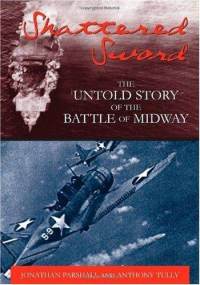
Every so often, I like to cleanse the palette with a bit of non-fiction mixed in among the sci-fi and horror fiction. Several years ago I read the stunning ‘Lincoln’ by David Herbert Donald. More recently I’ve enjoyed the work of Ken Auletta including ‘Googled’ and ‘Backstory’.
The war in the Pacific is something about which I am both utterly fascinated and completely ignorant. I love the sea and I was drawn to the stories of the big boats doing battle against one another for the last time. This sort of military engagement will absolutely never happen again, that much I knew going in. As I surveyed the history and the available resources, I decided I would wait on Guadalcanal, and start with Midway, as the next logical step (with the exception of Coral Sea) after Pearl Harbor. I had no idea what I was in for.
What went on to the north and west of this tiny atoll on June 4-7, 1942, literally defied anything I could have imagined. Shattered Sword, by Jonathan Parshall and Anthony Tully is a magnificent study of the conflict at Midway, told with minute-by-minute detail, from the Japanese perspective. The authors’ intention was to debunk some common myths, but as I was ignorant even of these widely held notions, it was all the more fascinating for me. I was shown both the prevailing narrative, and then confronted with the painstakingly documented sources which disproved a large part of the myth of Midway. It is a technical, yet exhilarating ride.
But even more that the intricacies of carrier warfare in the Pacific in 1942, I was struck by the stories of the men who fought and died on those three days. Somehow this book, with all of its technical sophistication, never lost sight of the human element. You simply cannot help but be moved by the fate of Japanese navy men on the carriers Akagi, Kaga, Hiryu and Soryu. And all through the ranks, on both sides of the conflict, there was heroism and failure, and always the brutal horror of war.
From the American pilots getting cut down by Japanese Zeros to the high commanders such as Nimitz and Yamamoto, this book captured the epic and slammed it squarely into my chest.

As my move to a Windows 7 work computer gets closer, I’m looking to tighten up my task management. I think there may be software implemented by the office that all eight of us will use, but I can’t necessarily count on or wait for that.
Some time ago I switched from the gorgeous native Mac app ‘Things‘ to the equally lovely web-app Flow. Flow is basically Things in the cloud. As far as I know, Things still doesn’t have a viable cloud sync, which means that mobile device must be synced over wi-fi. That’s an embarrassing state of affairs.
Flow is pretty much perfect task management, but its expensive: $10 per month or $100 for the year. But it’s so nice to look at and the platform is so solid and there’s no worry about switching from Mac to PC. And when users clamored for repeating tasks, they got right to it. There is still no native iPad app, but I’m sure this will be remedied in short order.
Flow greatest strength may be it’s collaboration facilities. This app/service is all about teams of people in different places working together and getting the shit done. Unfortunately, my use of task management is just for me. So I never had any opportunity to take advantage of the amazing team features in Flow.
Enter Wunderlist. This is, to be sure, not nearly as sexy as Flow and doesn’t have any of the collaboration potential, at least not yet. But it is perfect for my purposes. Free cloud based service – always synced. Free native apps for iPhone, iPad AND ANDROID! I never dreamed I would have viable task management on my Android phone, but now it works perfectly.
If my employer implements/mandates task management software, I will still use Wunderlist as a backup and for my personal GTD.
You can still benefit from my keen insight and wit by following the twitter feed, viewing the tumblr and sharing in Google Reader and Google+.
I might get too busy to blog, but usually not too busy to be social.
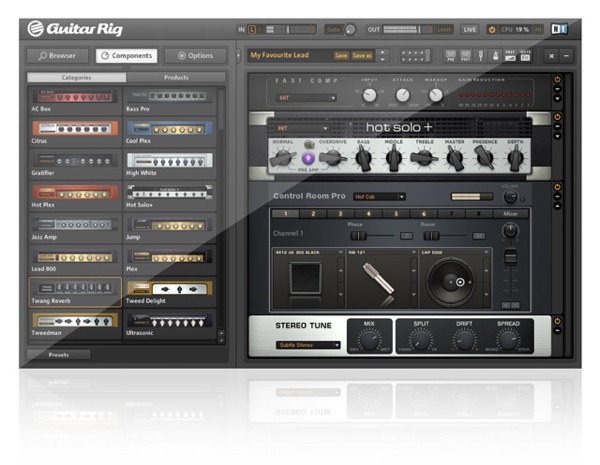
Guitar Rig was my first guitar-to-computer interface and it was really impressive. This latest version still looks impressive, but ever since I switched over to the Line 6 HD300, which has the A/D converter built into a steel pedal board, I haven’t had much use for Guitar Rig. Here’s the article about the newest version. A lot of these features are already available in the Line 6 product. Basically, the Line 6 works more like something you’d have on stage. The Guitar Rig (by Native Instruments – a GREAT company from Germany)seems more like a studio tool.